Japanese Traditional Crafts: What Ceramics and Lacquerware Can Teach You About Slowness
Most people encounter Japanese traditional crafts as souvenirs. A lacquered chopstick box at an airport shop. A small ceramic cup wrapped in tissue paper. These objects are beautiful, but buying them in that context gives little sense of what they actually are.
The craft tradition in Japan is not simply about objects. It is about a relationship between a maker, a material, and time — a relationship that took centuries to develop and that still shapes how these things are made today.
Let me state the core point directly: Japanese ceramics and lacquerware are not decorative arts in the Western sense. They are functional traditions that evolved alongside daily life — inside kitchens, on dining tables, in tea rooms — and the way they were made reflects a philosophy that values irregularity, restraint, and the visible presence of the maker’s hand.
Understanding that distinction changes how you look at a bowl or a tray.
The Kiln, the Clay, and the Gap Between Making and Finishing
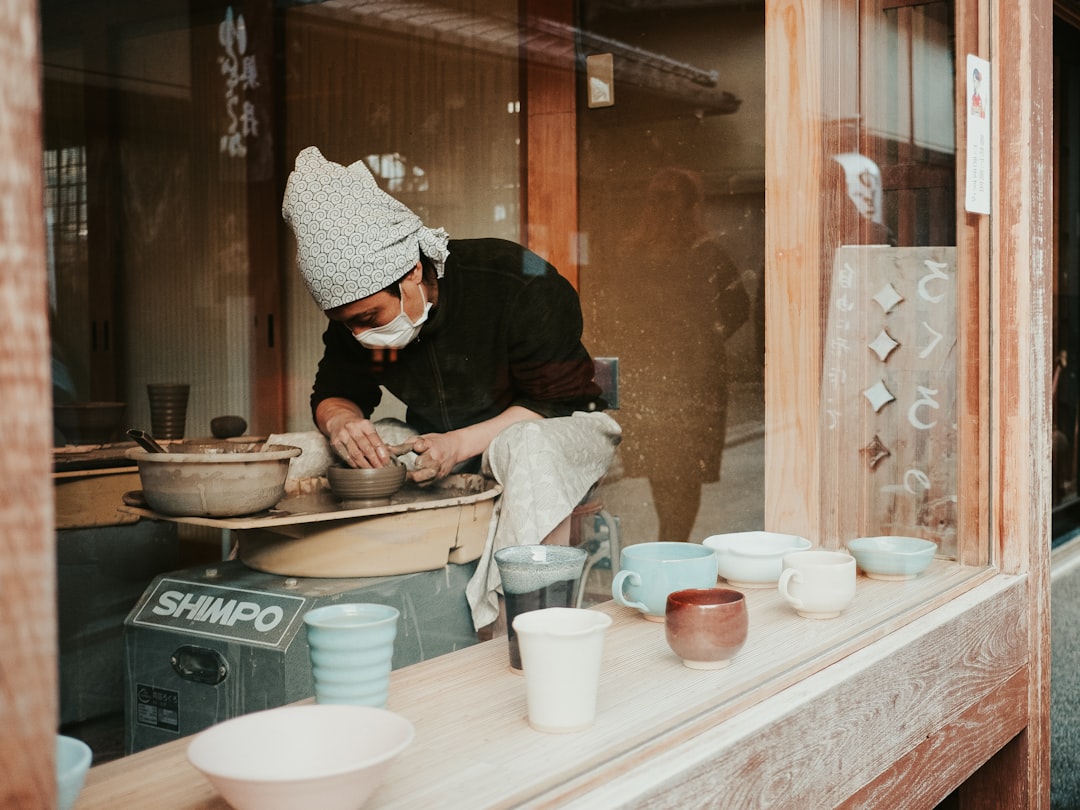
Japanese ceramics are divided into several major regional traditions, each shaped by local clay, local fuel, and local taste. Arita ware (Imari), Mino ware, Shigaraki, Bizen, Satsuma — these names refer not to a single style but to a place and a lineage.
The difference between a Bizen piece and an Arita piece is not only aesthetic. Bizen pottery is unglazed, fired at high temperatures in traditional anagama kilns for up to two weeks. The colors come entirely from ash deposits and flame patterns during the firing — the maker cannot predict the result with precision. Arita ware, by contrast, developed under influence from Chinese porcelain techniques and is known for white porcelain with painted decoration, much of it precise and intentional.
This distinction matters because it cuts against a common assumption: that “traditional” means “uniform.” In Japanese ceramics, the best-regarded pieces often carry marks of chance — a drip of natural glaze down the side of a Shigaraki jar, a dark flash across a Bizen cup. These are not flaws. They are considered evidence of the kiln’s participation in the making.
The term yōhen (窯変) refers to this transformation inside the kiln — color changes and surface effects the fire creates without the potter’s direct control. Collectors and practitioners of the tea ceremony have valued yōhen effects for centuries. Sen no Rikyū, the sixteenth-century tea master, is credited with elevating rustic, imperfect wares over polished Chinese imports — a preference that permanently shifted what Japanese ceramics considered beautiful.
One practical note for visitors: if you are looking at ceramics at a craft fair or a kiln shop, it is acceptable to pick up a piece and hold it. Weight, texture, and balance matter to how a ceramic object functions. Makers generally expect this. The unwritten rule is to hold it low, over the table or mat, and return it to exactly where you found it.
Lacquer Takes Time You Cannot Rush
Urushi lacquerware (shikki) is, among Japanese crafts, the one that most clearly makes time visible.
Urushi is the sap of the Rhus verniciflua tree (the Japanese lacquer tree). It is applied in thin layers, each of which must cure in a humid environment for twelve to twenty-four hours before the next layer can be added. A high-quality lacquered tray or bowl may go through forty to seventy layers. The process takes months, sometimes more than a year for complex pieces. This is not tradition for tradition’s sake — the layered structure is what gives urushi objects their extraordinary durability and depth of color.
The principal lacquerware-producing regions in Japan include Wajima (Ishikawa Prefecture), Echizen (Fukui Prefecture), and Yamanaka (also Ishikawa). Wajima-nuri is the most prestigious, known for a technique that includes a layer of jinoko (powdered diatomaceous earth) mixed with urushi to build a strong foundation base. Wajima pieces are expensive by any standard, and that price reflects actual labor time, not branding.
A common misunderstanding is that “lacquer” in other contexts means something similar. It does not. Much of what is sold as lacquerware internationally is either urethane-coated wood (fast, durable, uniform) or acrylic imitation lacquer. These are not urushi. The difference is visible under good light — urushi has a depth and slight translucence that synthetic coatings do not replicate — and functional: urushi pieces can be repaired through a traditional process called kintsugi‘s close cousin, nuri-naoshi, which restores the lacquer layer by layer.
If you are in a position to choose between a cheaper “lacquer” tray and a genuine urushi piece, the latter will cost more but behave differently over decades. Used regularly and hand-washed (never a dishwasher, never direct sunlight for storage), a Wajima tray can outlast its owner.
Visiting a Kiln or Lacquer Workshop: What to Expect
Craft production regions in Japan do receive visitors, though the experience varies considerably from a polished museum to a working family workshop.
In Arita (Saga Prefecture), the town itself is essentially a ceramics district — kiln shops, showrooms, and the Kyushu Ceramic Museum line the main streets. The Arita Tōki Ichi (Arita Porcelain Fair), held annually in late April and early May, draws buyers and collectors from across the country. For a quieter visit, the town outside fair season allows more conversation with individual potters.
Wajima is less immediately tourist-oriented. The Wajima Lacquerware Hall (Wajima Urushi-no-Mise) offers displays and demonstrations, but many of the actual workshops are small family operations. Some accept visitors by appointment; asking at a local tourist information center is the most reliable approach.
What I have found, in visits to production regions of this kind, is that the most informative conversations happen when you arrive without a tight schedule. A potter or lacquer artisan who is not busy with a demonstration will often talk at length about their material — not as a sales pitch, but because the material is genuinely what occupies their attention. The challenge is creating the conditions for that kind of exchange, which requires time and a willingness to sit with someone’s work before asking questions.
One thing to avoid: asking a craftsperson to justify the price of their work. It is an understandable question, especially when a single Wajima bowl costs as much as a piece of furniture. But the question tends to end conversations. The more productive framing is to ask about the process — how many layers, how long, what kind of wood — and let the price become self-evident.
How These Traditions Connect to Everyday Use
Japanese ceramics and lacquerware are not purely archival. They are still used in everyday contexts, and that use is part of what keeps the traditions alive.
A kaiseki meal at a serious Japanese restaurant will typically use ceramic and lacquerware that has been selected to match the season and the menu. The small lacquered tray under the sake cup, the flat plate that holds a single piece of sashimi, the covered lacquer bowl for clear soup — these are functional objects being used as they were designed to be used. Noticing them, rather than treating them as backdrop, gives a sense of how the crafts are embedded in daily life rather than quarantined in museums.
The tea ceremony maintains the deepest relationship with ceramics. Tea bowls (chawan) are the most collectible, most debated, and most studied ceramic form in Japan. A single old Raku tea bowl by Chōjirō, the sixteenth-century founder of Raku ware, can sell at auction for tens of millions of yen. But Raku bowls are also made by contemporary practitioners of the Raku family lineage (now in its fifteenth generation), and the tradition remains technically continuous from its origins.
This continuity is both impressive and occasionally misread. The existence of a living tradition does not mean nothing changes. Contemporary Japanese ceramicists work across a wide range outside regional traditions — there are potters making pieces that owe more to Scandinavian studio pottery than to Bizen — and the boundaries between “traditional” and “contemporary” are genuinely blurry at the working level. Calling something traditional is a description of lineage, not a guarantee of stasis.
*This article is based on information as of 2026-05-21. Temple and shrine hours, as well as event schedules, may change. Please check the official websites before visiting.
Travel often rewards what unfolds in the moment more than what was planned. This article is for reference; please make your final decisions based on current conditions and the season.
Closing Notes
- Japanese ceramics are regional traditions shaped by local materials, kiln techniques, and the specific aesthetic values of tea culture — “imperfection” in Bizen or Raku ware is not a flaw but a quality actively sought.
- Urushi lacquerware is defined by its production process: dozens of hand-applied layers, months of curing time, and a material that cannot be meaningfully replicated by synthetic substitutes.
- Visiting production regions — Arita, Wajima, Echizen, Shigaraki — gives access to craft in its native context, but the best encounters tend to happen without a schedule, when there is space for a craftsperson to talk about what they actually do.
The craft stays alive because people continue to use it. A bowl that is held regularly, a tray that carries tea things on a cold morning — these objects accumulate something that display cases do not allow. That is, I think, the most honest reason to seek out the real thing.
A fine season to visit Wajima or Arita — when the air is clear and foot traffic is modest — is early autumn. I intend to return then.
Photo by Alexis Banaag on Unsplash